It is time to write about Frau König. (Kindly note that all names and places have been changed)
Several years ago my husband, a bookseller, got a telephone call from an elderly woman who lived in a nearby town. She was looking for someone to buy her small private library of books, and he had been recommended to her. This, in itself, is fairly normal in his line of work. In fact, the people who call him with such requests are 90% elderly women from the area. They are moving — often their husbands recently passed away, and they are downsizing to an apartment in the city or a senior residence, and it’s finally time to get rid of all those old books, but of course no one can bear the thought of throwing them out. This is where my husband comes in — in a profession that calls for him to be part antiques dealer, part funeral home director, he has an assuring and knowledgeable manner from which they infer that their old books will be respected and will “go to a good home”. Most everybody understands that it’s Don’t Ask Don’t Tell, because no one wants to hear explicitly that their beloved, worn-out 1980s bestseller paperback with the parts underlined in red pen is going straight into the Altpapier container.
But back to our story. Frau König was planning to sell her apartment and move into a posh senior home on the other side of the lake. On the phone, she emphasized to my husband that she had some rather valuable books, and invited him to come to her house so that he could make an appraisal. When he got there, she sat him down in a chair and presented him with… three somewhat underwhelming and altogether worthless old books from the 1950s. He didn’t lie to her, but neither did he jump up and leave, and maybe she was just testing his reaction. She hinted at more treasures in her office downstairs. Frau König didn’t have a date set for the move, nor a seller for the apartment, but she must have felt that she had someone lined up to take her books. And so began a somewhat weird business relationship, where she would make lists of the books she was ready to part with, and my husband would drive over and pick them up, sometimes in little paper gift bags she’d had lying around. Virtually none of them had any worth to speak of, but somehow we felt that it wouldn’t be right to wave her off now. At some point, after a couple of years of this, I began to tag along, and she would make us mediocre coffee and chat about politics.
Unlike the other widows who were unloading their deceased husbands’ collections, Frau König had never married. She’d had what sounded like a pretty interesting career working for German embassies, though, which had her traveling to places like Russia and Ethiopia. She’d had connections with Africa and some mildly interesting art on the walls, and a lovely old grandfather clock (probably inherited). Her taste in books ran to travel literature and romance novels. She seemed lonely, although we couldn’t say for sure, as we weren’t that close. Our visits to Frau König were often preceded by a good measure of reluctance and eye-rolling, but often we’d both agree, in the car afterward, that we felt happy to have done a good deed, and that maybe we’d done ourselves a good deed in turn as well. It’s hard to explain.
When she finally had a moving date and the sale of her apartment taken care of, Frau König summoned us over to settle accounts regarding the price of the books. My husband had struggled for several months with a bad feeling about this, because he didn’t think she was going to be happy with his price, especially after that first “presentation” of her treasures. It turned out surprisingly well. She was taking a heavy old bookcase with her to the senior home, and the books that she wanted to keep with her were placed “just so” inside it. But she didn’t have anyone who could note their current order and put them back that way after the move. “That’s no problem” said my husband, while I whipped out my smartphone to photograph each shelf. In the end, she offered to settle our accounts that way – instead of payment of the books we had taken off her hands, we’d come to her new place and put her bookcases back in order. Thinking back on this, I am fairly sure she could have done this by herself. But we were happy to oblige (and relieved not to have to break the news to her about the low market value of her library).
I left for a visit to America just after that, and thought it would be nice to send a postcard congratulating Frau König on her new home. I include this just to show that we had started to become a bit fond of her, like an elderly neighbor who doesn’t get out that much any more. Plus she had moved to our side of the lake, so visiting was an actual option now and then.
My husband had arranged to see Frau König a few days after the big move (which happened while I was away). He found her in the lobby, asleep in an upholstered chair, so he quietly took a seat and waited for her to wake up. When she did, she didn’t recognize him. “And who are you?” she asked. But then her senses returned and she suggested a coffee in the residence’s cafe. She was distraught at the chaos in her apartment, she said; “everything is a mess!” He offered to help, but when they went to her apartment he was surprised to see everything in perfect order. She had even had her pictures hung on the walls. After chatting a little while longer, they agreed that we could come back when I returned from America, so that we would get her bookcase in order and maybe invite her out for a coffee. A week later my husband was at her old apartment, picking up a small sofa bed she had offered us. For some reason we had agreed, thinking it could serve as a day bed in the office. Honestly, I don’t know what we were thinking. Anyway, when he got there the new owners were already fully underway with renovation, and just wanted that pile of her stuff gone.
Three weeks later, after my return, there was no answer when he called her new telephone number. But we were busy, and just thought we’d try again later. You already know where this is heading.
The news arrived through an email from her nephew, Herr König, from up north in Bremen. Frau König had passed away in her sleep at the senior residence, just three days after my husband’s visit. She’d been in her new home for a mere nine days.
Our initial shock and genuine sadness were cut short by our encounter with the nephew, who had contacted us because he thought we might like to take those remaining books and the bookcase as well, as the apartment had to be cleared out in two weeks. Herr König, the executor to her estate, turned out to be a decent model for a Sackville-Baggins. We met him in his aunt’s nearly empty apartment, where he immediately starting complaining about the trouble and the timing of both her move and her demise, and then he complained pointedly about his aunt, despite our having just having shared warm and friendly stories of having gotten to know her. He suggested we could pick out what books we like, because “the recycling container is right at the end of the hall” and the rest could be carted there. My husband set aside a small pile of books, which seemed to irritate the nephew. In short, he expected money, and the fewer books we were taking, the less money he could expect. He also requested an offer for the bookcase, and when I gave him one (quite low, as we had not understood his intentions earlier, and had thought we were doing him a favor by helping to empty the apartment), he suppressed a laugh and replied that he’d just as soon have it taken to the dump. “Then you should do that”, my husband tersely interjected, and then he took the high road (and I love him for doing this) and explained to Herr König the value the various items he had set aside (“this may be something, in any event, don’t throw it out”) after which we wished him luck and departed – empty handed but utterly relieved. Back outside, we looked at each other and exhaled. “No wonder she seldom mentioned her relatives.”
Rest in peace, Frau K. I am sorry you couldn’t enjoy more of your new life, but I’m glad we had a small part in it.

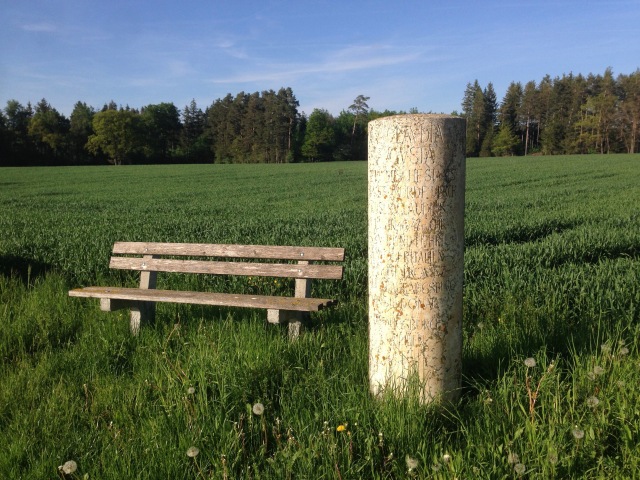 It’s not an original, of course, but a replica, with historical information written in German. This milestone is placed next to the route of the Via Claudia Augusta, here an unassuming gravel road, where it crosses Bahnhofstrasse near Leeder, west of the Lech (The Bahn in question is the old rail line between Landsberg and Schongau, which is only used for special tourist trains a few times in the summer.)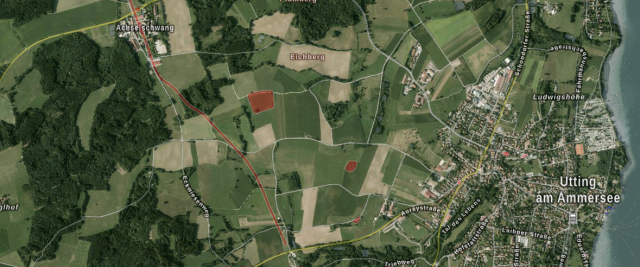





 The Practice Room